

Excise Tax in UAE is an indirect tax applied to specific products considered harmful to human health or the environment. Businesses involved in importing, producing, stockpiling, or distributing excise goods must understand registration requirements, applicable tax rates, record-keeping obligations, and compliance responsibilities.
Understanding UAE Excise Tax helps businesses avoid penalties, maintain compliance, and manage financial obligations effectively. For official regulations and updates, businesses can refer to the Federal Tax Authority website.
What Is Excise Tax in UAE?
Excise Tax is a selective tax imposed on specific goods that may have negative effects on public health or the environment. The purpose of Excise Tax is to discourage consumption of certain products while generating revenue to support public services and development initiatives.
Businesses dealing with excise goods must understand their obligations and ensure they comply with UAE tax regulations.
Why Excise Tax Compliance Matters
- Helps avoid penalties and regulatory issues
- Supports proper tax reporting
- Improves compliance management
- Strengthens business credibility
- Ensures smooth operations across the supply chain
Which Products Are Subject to Excise Tax?
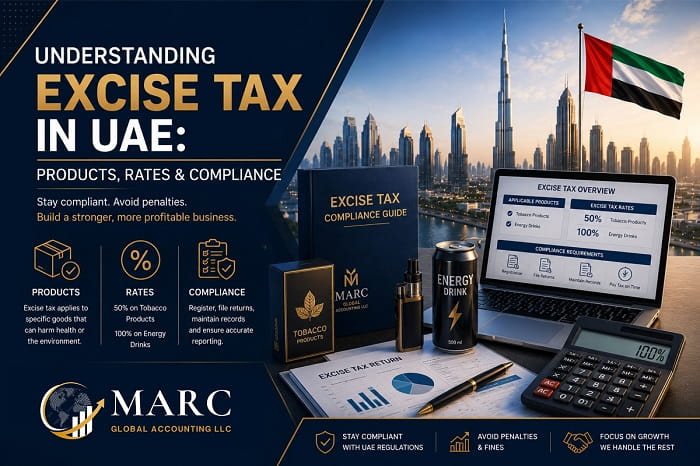
Certain products are currently subject to Excise Tax in the UAE. Businesses dealing with these goods should carefully assess whether registration and reporting obligations apply.
Common Excise Goods Include:
- Tobacco products
- Electronic smoking devices and tools
- Liquids used in electronic smoking devices
- Energy drinks
- Carbonated beverages
- Sweetened drinks
The scope of Excise Tax may evolve based on future regulations and policy updates.
“Excise Tax compliance requires more than registration. Businesses must maintain proper records, understand reporting obligations, and monitor tax liabilities consistently.”
— MARC Global Accounting LLCUnderstanding Excise Tax Rates
Different excise products may be subject to different tax rates depending on their classification under UAE tax regulations. Businesses should verify the latest applicable rates and classifications before calculating tax liabilities.
Because tax regulations may change, businesses should regularly review official guidance and compliance requirements.
Who Needs to Register for Excise Tax?
Businesses may need Excise Tax registration if they are involved in importing, producing, storing, releasing, or stockpiling excise goods within the UAE.
Registration obligations depend on the nature of the business activity and the products involved.
Businesses Commonly Affected Include:
- Manufacturers
- Importers
- Distributors
- Warehouse operators
- Retail businesses dealing with excise goods
- Supply chain operators
Key Compliance Requirements
Businesses subject to Excise Tax must maintain proper records and comply with reporting obligations established by the Federal Tax Authority.
- Excise Tax registration
- Accurate product classification
- Proper invoicing and documentation
- Regular record maintenance
- Timely tax return filing
- Payment of applicable tax liabilities
Common Excise Tax Compliance Challenges
Many businesses experience difficulties because of incorrect product classification, poor record keeping, delayed registrations, or misunderstanding of reporting requirements.
- Incorrect tax calculations
- Missing supporting documents
- Incomplete inventory records
- Late return submissions
- Improper product classification
- Weak compliance processes
For the latest Excise Tax announcements and updates, businesses can visit the FTA Announcements Portal.
How Excise Tax Impacts Businesses
Excise Tax can affect product pricing, inventory management, cash flow planning, and overall financial performance. Businesses should understand the operational and financial implications of Excise Tax and develop strong compliance procedures.
Effective planning helps reduce risk and improves financial control.
How MARC Global Supports Excise Tax Compliance
MARC Global Accounting LLC assists businesses across the UAE with Excise Tax registration, compliance reviews, record management, tax reporting, and advisory services. Explore our complete range of Accounting & Tax Services.
- Excise Tax registration support
- Compliance assessment and review
- Product classification guidance
- Tax reporting support
- Accounting and bookkeeping assistance
- Ongoing tax advisory services
Best Practices for Excise Tax Compliance
Businesses dealing with excise goods should establish strong internal controls and compliance procedures to reduce risk and improve reporting accuracy.
- Maintain accurate inventory records
- Monitor excise product classifications
- Keep supporting documentation organized
- Review tax obligations regularly
- Monitor filing deadlines
- Conduct periodic compliance reviews
- Work with experienced tax advisors
Need Help With Excise Tax Compliance?
MARC Global Accounting LLC provides expert Excise Tax, VAT, Corporate Tax, accounting, bookkeeping, and compliance support for businesses across the UAE. View our Case Studies or Contact Us to discuss your requirements.
Discuss Your Excise Tax RequirementsRelated Resources
- Accounting & Tax Services
- Contact MARC Global
- UAE Accounting Case Studies
- Federal Tax Authority
- FTA Announcements