

Preparing your business for an audit in the UAE is essential for maintaining financial transparency, regulatory compliance, and stakeholder confidence. Whether your business is a startup, SME, free zone company, or established enterprise, proper audit preparation helps reduce risks, avoid delays, and ensure a smoother review process.
Businesses operating in the UAE are expected to maintain accurate accounting records, supporting documentation, and compliance procedures. Proper preparation not only simplifies the audit process but also strengthens overall financial management. For official updates and compliance guidance, businesses can refer to the Federal Tax Authority.
Why Audit Preparation Matters
An audit helps verify the accuracy of financial records, assess compliance procedures, and identify potential weaknesses in financial management. Businesses that prepare properly often experience a more efficient audit process and stronger confidence in their financial reporting.
Good audit preparation also demonstrates professionalism, transparency, and accountability to stakeholders, investors, financial institutions, and regulatory authorities.
Benefits of Audit Readiness
- Improved financial transparency
- Stronger compliance management
- Better internal controls
- Reduced audit delays
- Greater stakeholder confidence
- Improved business decision-making
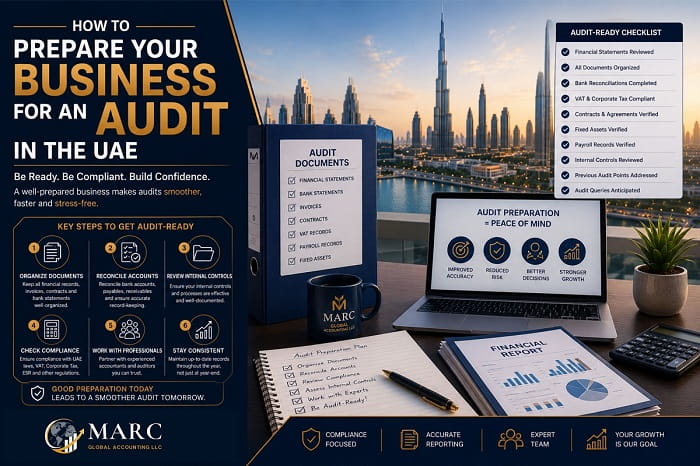
1. Maintain Accurate Accounting Records
Accurate accounting records are the foundation of every successful audit. Businesses should ensure all financial transactions are properly recorded, categorized, and supported by documentation.
This includes sales records, purchase invoices, expense records, payroll information, bank statements, and other financial transactions.
2. Organize Supporting Documents
Auditors typically review supporting documentation to verify financial records. Businesses should maintain organized records that can be accessed quickly when required.
Common Documents Auditors May Review
- Invoices and receipts
- Bank statements
- Contracts and agreements
- Payroll records
- VAT documentation
- Corporate Tax records
- Financial statements
- Inventory records
3. Review Financial Statements
Before an audit begins, businesses should review their financial statements for accuracy and completeness. Any discrepancies should be investigated and resolved before auditors start their review.
Well-prepared financial statements help streamline the audit process and improve confidence in reported figures.
“Audit preparation is not a last-minute activity. Businesses that maintain accurate records throughout the year are better positioned for compliance, growth, and financial confidence.”
— MARC Global Accounting LLC4. Reconcile Bank Accounts Regularly
Bank reconciliations help ensure accounting records match actual banking activity. Regular reconciliation helps identify missing transactions, duplicate entries, and financial inconsistencies before an audit begins.
Businesses should perform reconciliations consistently and maintain supporting documentation for review.
5. Review VAT Compliance Records
Businesses registered for VAT should ensure VAT returns, invoices, tax records, and supporting documents are accurate and complete.
Strong VAT record management helps demonstrate compliance and reduces potential audit concerns.
6. Verify Corporate Tax Documentation
As Corporate Tax compliance becomes increasingly important in the UAE, businesses should maintain proper records supporting tax calculations, registrations, and reporting obligations.
Well-organized tax documentation improves readiness for compliance reviews and audits.
7. Assess Internal Controls
Internal controls help prevent errors, fraud, and financial inconsistencies. Businesses should review approval processes, authorization procedures, segregation of duties, and financial controls before an audit.
Strong controls improve operational efficiency and reduce risk exposure.
8. Review Payroll and Employee Records
Payroll documentation should be accurate, complete, and properly maintained. Businesses should ensure employee records, salary details, contracts, leave records, and payroll reports are readily available.
This helps support compliance reviews and employee-related audit procedures.
9. Conduct a Pre-Audit Review
Many businesses benefit from conducting an internal review before the formal audit begins. A pre-audit review can help identify missing records, documentation gaps, compliance concerns, and financial inconsistencies.
Addressing issues early helps reduce audit challenges and improve readiness.
10. Work With Experienced Accounting Professionals
Professional accountants and advisors can help businesses prepare documentation, review records, strengthen compliance procedures, and support communication throughout the audit process.
Expert guidance often reduces risk and improves overall audit efficiency.
Common Audit Preparation Mistakes
- Poor record organization
- Missing invoices and receipts
- Delayed bank reconciliations
- Incomplete VAT records
- Weak internal controls
- Unverified financial statements
- Incomplete payroll documentation
For important updates and announcements, businesses should regularly review the FTA Announcements Portal.
How MARC Global Supports Audit Readiness
MARC Global Accounting LLC helps businesses across the UAE prepare for audits through bookkeeping reviews, financial reporting support, VAT compliance assessments, Corporate Tax documentation reviews, and advisory services. Explore our complete range of Accounting & Compliance Services.
- Audit readiness assessments
- Bookkeeping review services
- Financial statement preparation
- VAT compliance reviews
- Corporate Tax documentation support
- Payroll compliance assistance
- Business advisory services
Best Practices for Audit Success
- Maintain accurate accounting records year-round
- Organize supporting documentation properly
- Perform regular bank reconciliations
- Review VAT and Corporate Tax compliance
- Strengthen internal controls
- Conduct internal reviews before audits
- Work with experienced accounting professionals
Need Help Preparing for an Audit?
MARC Global Accounting LLC provides expert audit readiness support, bookkeeping reviews, financial reporting, VAT compliance, Corporate Tax assistance, and business advisory services across the UAE. View our Case Studies or Contact Us to discuss your requirements.
Discuss Your Audit RequirementsRelated Resources
- Accounting & Compliance Services
- Contact MARC Global
- UAE Business Case Studies
- Federal Tax Authority
- FTA Announcements